Friday, 9 November 2012
Scanning using Microsoft's Kinect

Pointcloud rendering using Blender
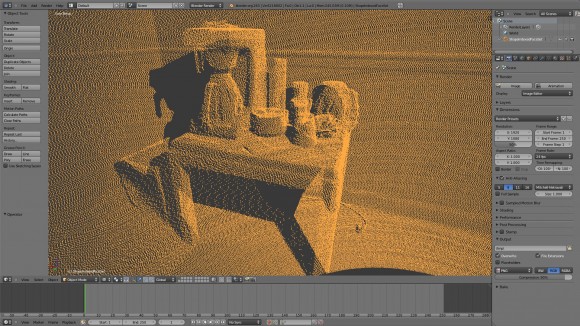
Found a few interesting tutorials about rendering Pointcloud data in Blender. You will need to have captured the data/scene using a 3D scanner though and import it in Blender. It does generate a huge amount of datasets but the XYZ Point Reducer program from Christian Storay apparently reduces the data of the scan without reducing the data the scan itself has.
http://www.blendernation.com/2012/09/25/getting-point-clouds-into-blender/
http://www.blensor.org/node/27
The scans can also be used on Reconstructme
Wednesday, 7 November 2012
Motion Tracking
I have been testing the motion tracking capabilities of Blender as it will play a part in the making of my animations this year. It was a tricky attempt as the tracking markers couldn't keep up with the motion of the physical camera, resulting with the model flickering and un-synced motion with the scene[but that is hopefully not a wholly bad thing]. Below is a break down of how it was made:

The scene was filmed with the smoothest pan possible as any blurriness would mean that the tracking would become more complex, as my previous attempts proved to be.

High levels of contrast had to be picked as they helped in the tracking of the motion of the physical camera. Markers were dropped into the scene to track those key pigments.


I then attempted to make the 3D model fit in the scene using a blend of lighting and material colour.
Thursday, 1 November 2012
Chronogram of DLR Pixel Space

Wednesday, 31 October 2012


Sunday, 28 October 2012
Subscribe to:
Posts (Atom)